How to Plan a Trip to the Netherlands
You’ve decided to plan a trip to the Netherlands – way to go! The Netherlands are a great introduction to Europe for folks who’ve never been, and a great place to explore for European vets looking to dive deeper into a country’s culture and customs.
Planning A Trip To The Netherlands – What You Need To Know
It’s pretty easy to have a great time in the Netherlands, but you’ll have to make some choices. Some of your most important decisions involve:
- The best time of year for you to visit the Netherlands
- How to see Dutch tulips
- How to get around in the Netherlands
- To bike or not to bike
- Whether to take a canal cruise
- The museums and other cultural centers you’ll want to visit
-
Off-the-beaten-path places to check out
The Best Time Of Year To Visit The Netherlands
As we’ve mentioned in other posts, one of the great things about visiting many European countries is there’s really no bad time to visit.
Of course, a lot depends on specific things you might want to do (like bike) or see (like tulips), but the Netherlands really are a time-agnostic destination if you’re looking to:
- Drink coffee in cafes
- Wander down cobblestone streets
- Visit bakeries and nibble treats
- Browse bookstores
- Linger in museums
- Ride trains
In fact, late winter and early spring are some of the best times to do these things because the streets and museums are less crowded, hotels have their best rates, and the volume of bike traffic is down (a little).
Amsterdam gets crowded during Spring Break, and then again in April. Considering that you’ll likely spend some time in Amsterdam no matter where your Dutch vacation takes you, it’s something to consider.
Spring starts in earnest in April and continues through May. Summers are relatively temperate, though all of Europe has been hotter than normal lately. Fall doesn’t kick in until mid-October, and November is generally quite pleasant.
How To See Tulips In The Netherlands
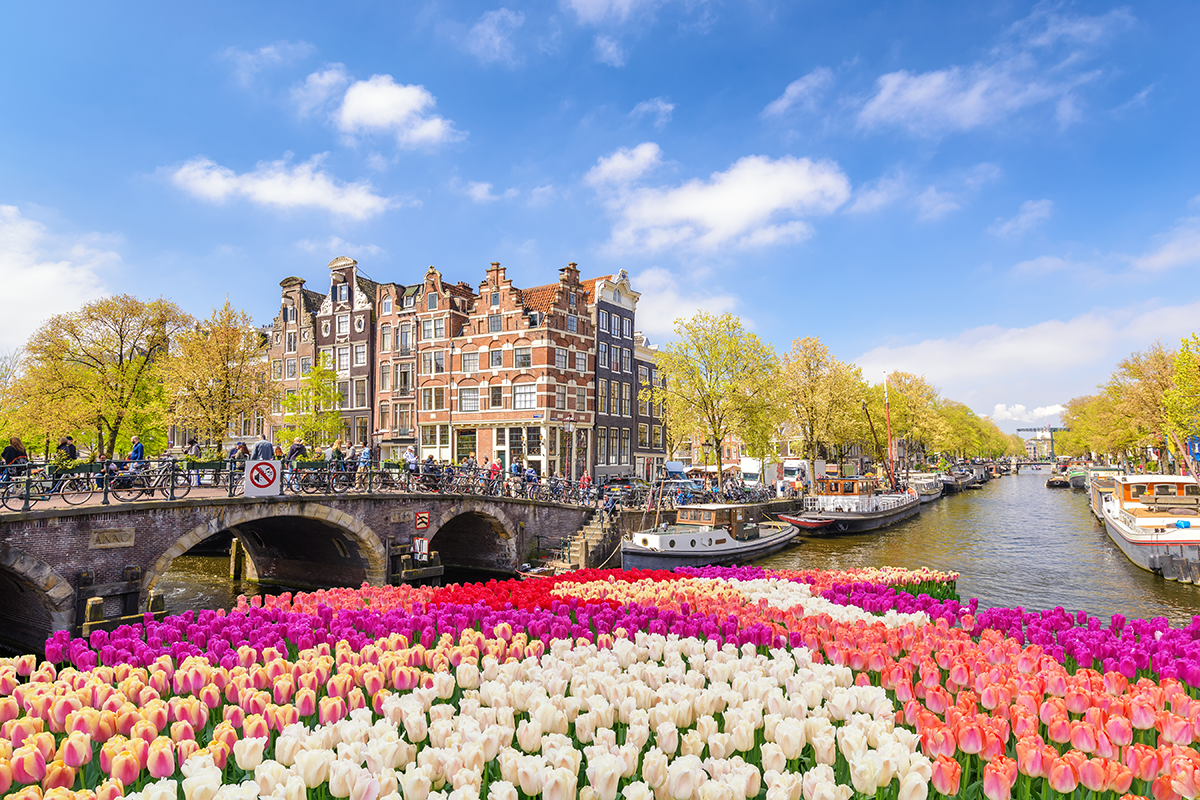
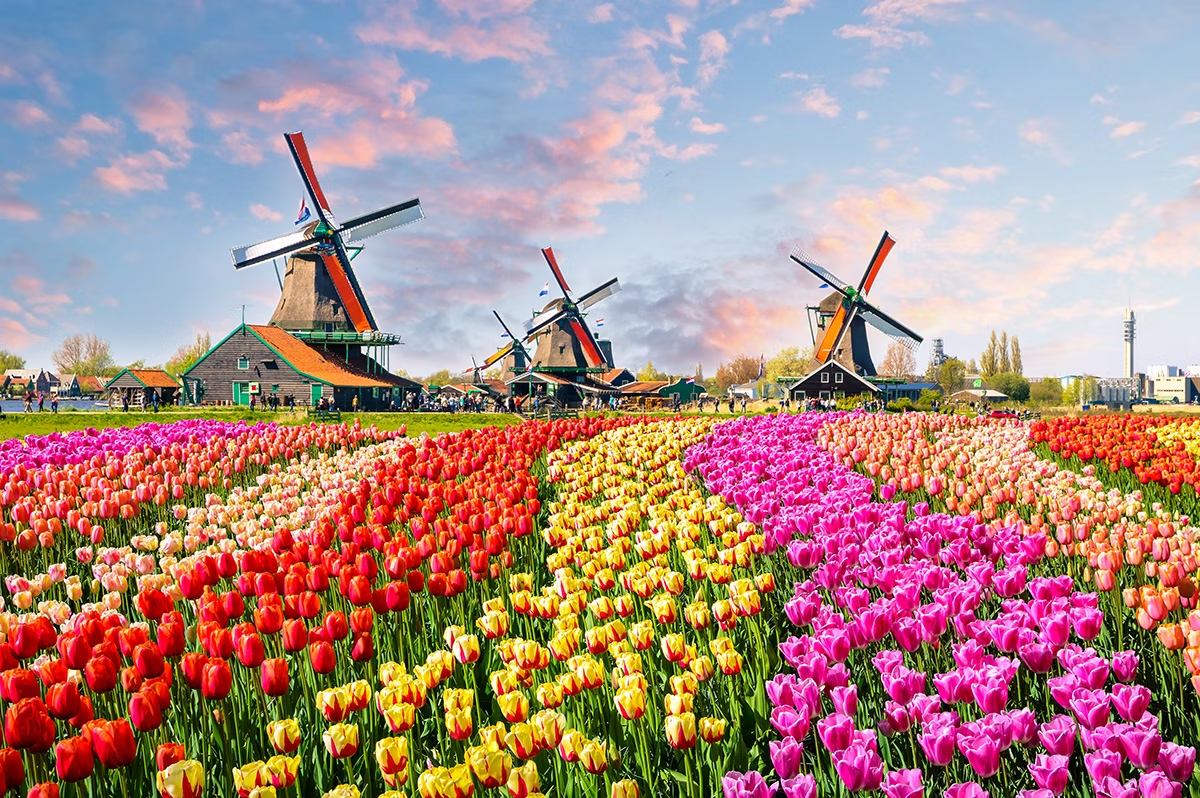
Speaking of seasons, spring is the time to see Dutch tulips, and the most famous place to see them is the Keukenhof Gardens, an hour or so outside of Amsterdam.
Tulip season doesn’t really get going until the second week of April. You can visit the gardens several weeks before that, but you’ll largely have to content yourself with crocuses and cut flowers in the display areas. (The tulip fields are spectacular, but so are the cut flowers. Don’t miss them!)
You have multiple options for seeing the tulip gardens. You can:
- Take an excursion offered by your cruise line (if you’re taking a river cruise through the Netherlands)
- Take a tour bus from Amsterdam (which your hotel can help arrange)
- Take the train, and take a bus from the station to the gardens
- Rent a car and drive yourself
However you decide to see the gardens, buy tickets in advance.
Keukenhof isn't the only tulip garden in the Netherlands. Other gorgeous gardens and/or tulip farms include:
- Bollenstreek Flower Fields, near Lisse and surrounding villages
- De Tulperij, a family-run tulip farm also near Lisse
- The Tulip Barn, another more intimate tulip farm, again near Lisse
- Tulip Experience Amsterdam, with millions of tulips and a show garden
With all of these, the same basic advice applies:
- Contact the gardens ahead of time to secure a spot
- Reserve or arrange transportation
- Bring a camera
One more thing: You probably won’t be able to take tulip bulbs home with you because of agricultural restrictions. Ask before you buy if the bulbs are okay to take back to the States.
Getting Around In The Netherlands
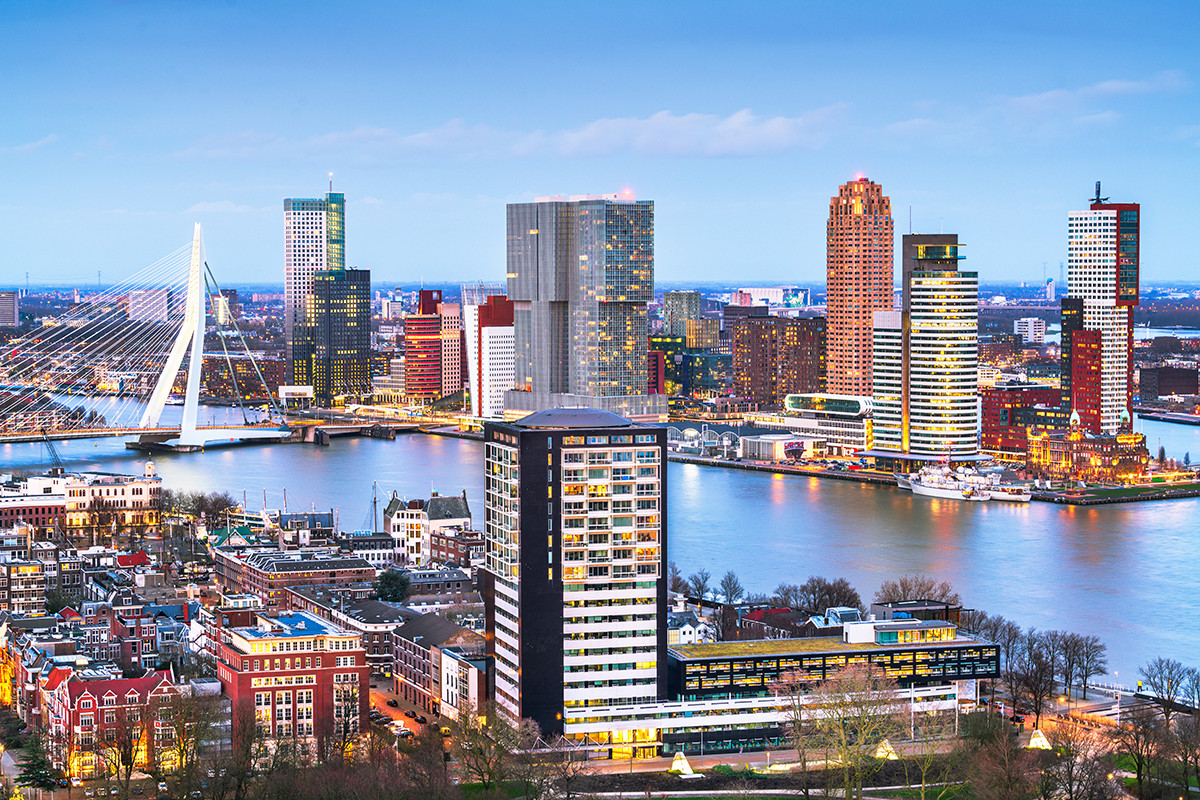
Even though the Netherlands have more canals than Texas has tumbleweeds, they won’t impede you driving or taking the train.
Speaking of which, the main means of getting around the Netherlands are:
- Car
- Train
- Mass transit
- Bike
Let’s look at each separately.
Driving around the Netherlands
Driving in Amsterdam can be a bit much; not necessarily because of the traffic (which isn't appreciably worse than any major European city) but because of bicycles.
We’ll discuss biking later, but from a driver’s standpoint bikes are a scourge. They’re even more dangerous and annoying since e-bikes have come along, and particularly the motorcycle-like e-bikes that many children can and do ride in the Netherlands.
Eternal vigilance is the rule for driving in major Dutch cities, but once you get outside of the city traffic moves freely and swiftly on well-maintained, mostly multilane roads.
Your only challenge in the countryside is knowing when to take an exit. Exits are well-marked, but everything’s in Dutch, which can be a baffling-looking language if you’re English-only.
However, that barrier can be overcome if:
-
You know a little German and sound out words; or
-
You drive with a companion who has Google Translate or its equivalent fired up
In general driving in the Netherlands is going to be a little more easy-going than driving in other European countries – just what you need as you’re finding your way.
Taking the train in the Netherlands
If you’re traveling between cities in the Netherlands, trains are your best option by far. They’re frequent, fast, clean, and relatively cheap.
Because the Netherlands is a compact country, train travel in-country takes very little time. Most destinations are only an hour or two from Amsterdam. You can easily do a day trip out of Amsterdam to practically any other destination in the Netherlands and be back to Amsterdam for a late dinner.
Even better, Amsterdam is a great hub for hopping to London and Paris.
Once you start taking trains in Europe you won’t want to get around any other way.
Netherlands Rails has all the details.
Mass transit in the Netherlands
Just as you’d expect, mass transit in the Netherlands is clean, fast, orderly, on time, and relatively inexpensive.
Amsterdam has above-ground trams, a below-ground metro, and frequent buses.
Other cities aren’t quite as elaborate with their mass transit, but most cities have buses that can get you around.
And a bonus: Many Netherlanders speak reasonably good English, so asking where a bus goes or when another bus might be coming will generally get you reliable answers.
Biking in the Netherlands
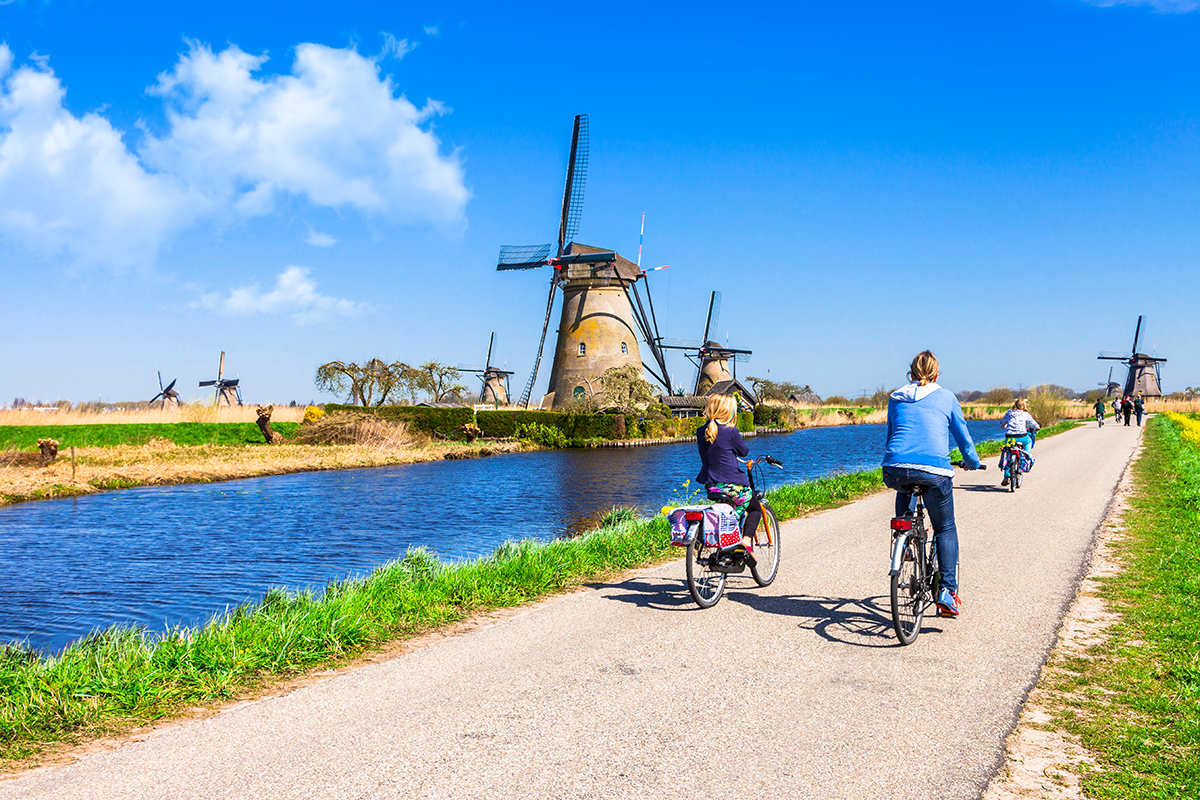
In your mind’s eye, the Netherlands is a place where everyone straps on their wooden shoes and bikes to the market over arched bridges that cross canals, with windmills turning slowly in the background.
The wooden-shoes thing is almost entirely in the past, but arched bridges, canals, windmills, and bikes everywhere – those are still things in the Netherlands.
Particularly bikes.
Most major Dutch cities have designated bike lanes. “Well, yeah,” you say. “So does Chicago.” The difference between a bike lane in Chicago and one in the Netherlands is that in the Netherlands, the bike is king.
As a pedestrian in the Netherlands, you need to look both ways before crossing the street – for bikes. As a driver, you always have to make sure the intersection is clear – of bikes.
As mentioned earlier, the rise of motorcycle-like e-bikes has made bike awareness even more important. Collisions with one of these bikes, which can routinely top 30 mph, do not end well.
Given that, why would you want to bike in the Netherlands?
Several reasons:
- There’s safety in numbers
- Bike awareness is extremely high
- There are many tried-and-tested routes
- Infrastructure is rock-solid
- The country is F-L-A-T flat
Biking in Amsterdam is a bit like driving in New York City – bewildering at first, but you get used to it. Stick with the traffic flow and you’ll be fine.
Anywhere outside of Amsterdam, biking is a joy. It’s like the country was made to be explored by bicycle.
Whether you rent a bike and create your own excursion or go with a bike-tour operator like Lifecycle Adventures, you’re going to have a good time biking in the Netherlands.
A couple of tips if you bike it yourself:
- Test the gear before committing to a rental. Make sure wheels turn smoothly; tires are properly inflated, and shifters and brakes work.
- Get a good (paper) map. Plot your route carefully and pay close attention at intersections. Confirm your route at the bike shop when you rent.
- Use your phone as a backup map and a translation medium.
- Ask for directions if you feel you’re lost.
- Wear a helmet.
- Have a plan if your bike breaks down. Can you call the rental agency or bike shop? Are you expected to change a flat tire yourself? (Hope not).
- Know the exchange rate between kilometers and miles (one kilometer equals .62 miles).
- Don’t be too ambitious. Don’t plan a 50-mile bike ride if all you’ve done in the past year is trundle around the block.
On the other hand, if you’ve never ridden an e-bike, now’s your chance. Many Dutch have switched to these bikes because they’re so fun to ride, with zero learning curve.
Some e-bike must-dos:
- Understand the top speed. If you’ve never ridden an e-bike before, ask for one that caps the top speed at 18-20 mph.
- Understand power delivery. An e-bike that helps you pedal is better than one than can propel you without pedaling, because you have more control.
- Know your range. E-bikes can turn into bricks when the battery dies. Ideally, you want a bike that lets you pedal even when the battery is dead.
- Choose a good brand. Gazelle bikes are made in the Netherlands and check all the boxes .
Canal cruises in the Netherlands
River cruises are a popular way for many Americans to see the Netherlands for the first time.
However, if you’re looking to explore the Netherlands further in a more intimate way, canal cruises are a cool option.
These smallish boats go places the big river cruisers can’t, often include bike excursions, and give you an up-close look at the country, its history and its culture.
Canal cruises go slowly on smaller waterways, generally out of Rotterdam or Amsterdam, often as far north as Friesland.
A couple of caveats with these cruises:
- They’re expensive. High overhead, uber-personalized service and five-star dining will do that
- They’re not particularly scenic. It’s not the cruise’s fault. The countryside is what it is.
If you’re interested, check out the offerings from lines like Aurora and European Waterways.
Museums And Cultural Centers In The Netherlands
Amsterdam is obviously the cultural heart of a country that’s produced a whole school of painters, Rembrandt most prominent among them, as well as perhaps the most compelling painter of all time, Vincent Van Gogh (pronounced “Van Gockh” in the Dutch manner).
If museums are your thing, Amsterdam is the place to start. The city’s museum plaza is a square of greenspace rimmed by the country’s cultural treasures:
- The Stedelijk Museum of Modern Art
- The Van Gogh Museum
- The National Art Museum (Rijksmuseum)
- The Opera House
Each museum is worth visiting, but depending on your artistic preferences, you may spend more time in one or another.
The Van Gogh and modern-art museums sometimes share exhibits, making it possible to see both with one admission.
Taken by itself, the Van Gogh museum is a trifle disappointing, only because the artist’s most iconic paintings hang in other museums around the world. On the other hand, the National Museum is the place to see many of the great paintings of the Dutch masters – Rembrandt, Hals, Vermeer, and others.
But the Netherlands has many more museums worth visiting outside of Amsterdam, including:
- The Frans Hals Museum in Haarlem, which has a nice modern art collection in addition to paintings by the Dutch master
- Mauritshuis in The Hague, home to Vermeer’s Girl with a Pearl Earring and other Dutch Golden Age masterpieces
- The spectacular Museum Voorlinden in Wassenaar, which offers modern art in a thoroughly modern setting
- The Kröller-Müller Museum in Otterlo, which boasts the world’s second-largest collection of Van Gogh paintings and a world-class sculpture garden, all set inside a national park
Off-The-Beaten Path Destinations In The Netherlands
In the Netherlands the beaten path is Amsterdam and environs. To see more of the country, take day trips or excursions to cities like:
- Gouda: Great cheese and a cozy ambiance
- Utrecht: Full of history
- Leiden: Full of charm
- The Hague: Home to the World Court, a true international city
- Groningen: College town deluxe
There are many more, and with a country so compact and easy to get around, it’s not hard to find them for yourself.
Buying Travel Insurance For The Netherlands
You’ll probably have some spur-of-the-moment expenses in your trip to the Netherlands, but you’ll have a lot of prepaid expenses too – things like airfare and hotels.
That’s why it makes sense to buy travel insurance for your trip to the Netherlands.
Berkshire Hathaway Travel Protection’s wide array of travel insurance plans lets you cover everything from a river cruise to a bike tour, with an easy purchase process and super-quick claim service.
Planning A Trip To The Netherlands: The Bottom Line
The Netherlands are compact, friendly and easy to get around, making them the perfect destination for a fun, hassle-free European vacation.
With good planning and travel insurance, what’s there to worry about? When the destination is the Netherlands, the answer is, “Practically nothing.”

Questions About Travel Insurance?
Check out our online guide, "What Is Travel Insurance All About?" We've provided in-depth answers to all your travel insurance questions, starting with the basics.